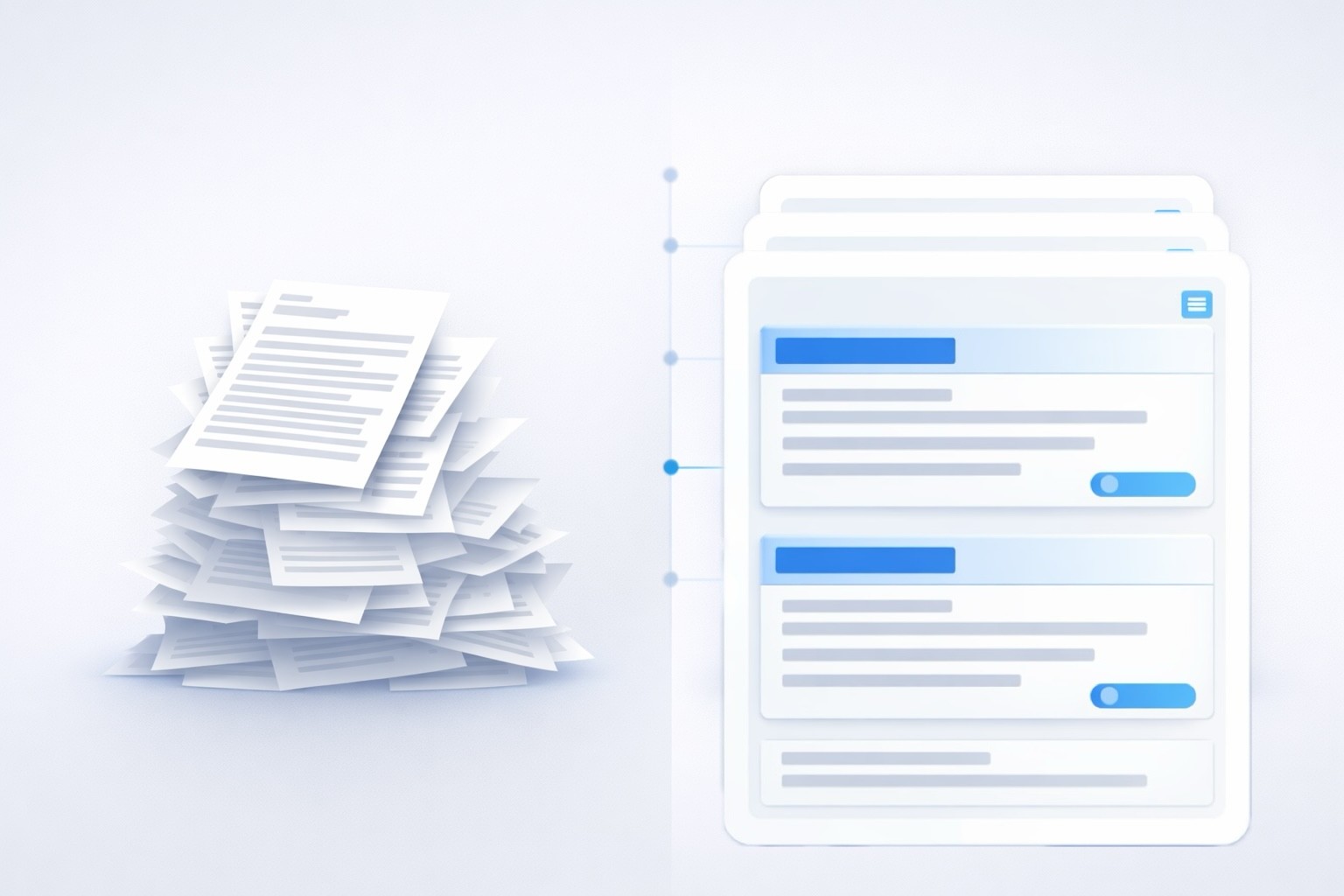
Illustrative example: encounter-based notes accumulate as separate documents, while Stream builds a living, problem-based record across visits.
On the first visit, Stream and Heidi often feel similar. You speak, and a note gets done faster than typing — which is genuinely helpful.
But clinical care is longitudinal. The real work happens on the second visit, the fifth visit, and the follow-up you didn’t expect. That’s where tools diverge.
Heidi is designed to generate fast, encounter-level notes. Each visit produces a new document that lives alongside the others. Over time, clinicians are left to mentally reconstruct the patient story from a growing pile of disconnected notes.
Stream is built differently. From the start, documentation is organized by patient and by medical problem. Each visit updates existing problem narratives instead of starting over. Context is pulled forward automatically, so Stream becomes more useful with every encounter.
Stream is designed for clinicians who want documentation to accumulate meaning over time, organized by medical problem.
Stream
Primary care and specialty clinicians managing chronic conditions, longitudinal care, and complex patient histories.
Heidi AI
Clinicians who primarily want well-written documentation that fits their templates with minimal configuration.
Stream treats documentation as a longitudinal clinical record, organized by persistent medical problems.
Heidi AI focuses on generating clear, well-written clinical notes for individual encounters.
Feature & Pricing Comparison
Features
Stream
Heidi
Before the Visit
Stream allows clinicians to review prior problems, notes, and context before the visit.
Heidi AI typically begins each visit without structured access to problem-level longitudinal history.
During the Visit
Stream structures documentation by problem during the visit and incorporates prior narrative automatically.
Heidi AI transcribes and summarizes the current encounter into a complete note.
After the Visit
Stream produces documentation, tasks, and structured updates that persist into future visits.
Heidi AI produces finalized encounter notes without built-in longitudinal carry-forward.
Across Visits
Stream links documentation across visits by problem, reducing redocumentation and drift.
Heidi AI treats visits largely as standalone events.
Stream Features
Stream uses problem-based organization as the primary unit of documentation.
Heidi AI organizes notes primarily by encounter rather than by problem.
Stream actively reuses prior narrative to improve accuracy and completeness over time.
Heidi AI relies mainly on current-visit information. Users can manually link up to 3 encounters for additional context.
Stream is designed to work across diverse EHRs and practice types without enterprise lock-in.
Heidi AI is often used as a note-generation layer on top of existing EHR workflows.
Stream offers deep customization of templates, problem structure, and documentation style.
Heidi AI emphasizes ease of use and polished note output with fewer structural controls.
Clinicians who prefer minimal setup and do not need longitudinal chart memory may find Stream more than necessary.
Heidi AI excels at producing clean, readable encounter notes with minimal clinician input.
Stream
Problem-based documentation
Longitudinal context across visits
Custom templates
Task extraction
Heidi
Clean AI-generated notes
Minimal setup
Readable summaries
Different tools for different documentation needs