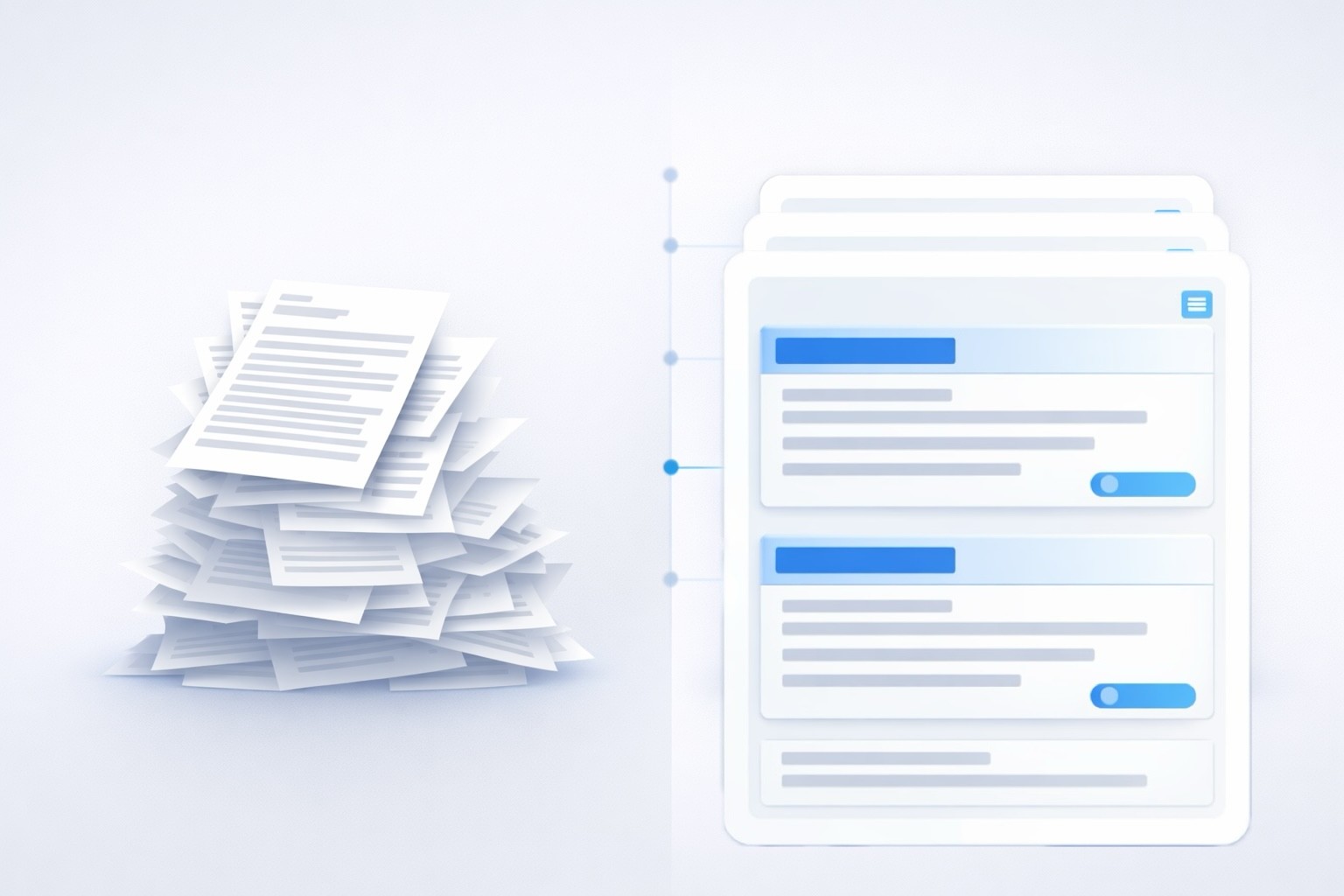
Illustrative example: encounter-based notes accumulate as separate documents, while Stream builds a living, problem-based record across visits.
On the first visit, Stream and Freed often feel similar. You speak, and a note gets done faster than typing — which is genuinely helpful.
But clinical care is longitudinal. The real work happens on the second visit, the fifth visit, and the follow-up you didn’t expect. That’s where tools diverge.
Freed is designed to generate fast, encounter-level notes. Each visit produces a new document that lives alongside the others. Over time, clinicians are left to mentally reconstruct the patient story from a growing pile of disconnected notes.
Stream is built differently. From the start, documentation is organized by patient and by medical problem. Each visit updates existing problem narratives instead of starting over. Context is pulled forward automatically, so Stream becomes more useful with every encounter.
Stream is built for clinicians who need accurate, organized documentation that carries forward across visits — not just fast notes.
Stream
Independent primary care, DPC, and specialty clinicians who care about longitudinal accuracy, problem lists, and clinical continuity.
Freed AI
Clinicians who want the fastest possible note for single visits and don’t need chart memory or longitudinal structure.
Stream treats documentation as a living clinical record, organized by medical problem and refined over time.
Freed focuses on rapid generation of a complete note for a single encounter, prioritizing speed over longitudinal structure.

Feature & Pricing Comparison
Features
Stream
Freed
Before the Visit
Stream helps clinicians review problems, context, and tasks before the visit using accumulated chart memory.
Freed generally starts fresh each visit, without structured access to prior problem-level context.
During the Visit
Stream listens, structures notes by problem, and incorporates prior documentation as context during the visit.
Freed transcribes and summarizes the current conversation into a complete note.
After the Visit
Stream generates documentation, tasks, and structured updates that persist into future visits.
Freed produces a completed note after the visit, typically without ongoing carry-forward.
Across Visits
Stream maintains continuity across visits by linking documentation to persistent problem histories.
Freed treats each visit independently, with limited cross-visit continuity.
Stream Features
Stream organizes documentation by medical problem, allowing multiple diagnoses and codes to live under clinician-defined problem buckets.
Freed produces encounter-based notes with limited internal structure beyond the visit.
Stream actively pulls forward relevant prior narrative to improve completeness and reduce redocumentation.
Freed relies primarily on the current visit conversation, with limited reuse of past context.
Stream is designed to work across many EHRs and workflows without requiring enterprise integrations.
Freed is often positioned as a lightweight scribe that fits alongside existing EHR note workflows.
Stream offers deep customization of templates, problem structure, and documentation style.
Freed offers simpler configuration focused on speed and minimal setup.
Clinicians who only need very fast, one-off notes without concern for longitudinal accuracy may find Stream more than they need.
Freed excels at quick note turnaround for episodic care or clinicians who value speed above structure.
Stream
Maintains context automatically across visits
Reduces review burden, not just creation time
Problem-centric view aligns with clinical reasoning
Freed
Quick note turnaround
Lightweight, low-friction setup
Good for occasional documentation needs
Two tools built for different kinds of clinical work